As an Amazon Associate I earn from qualifying purchases.
Updated November 2026
Steel toe vs composite toe work boots is one of the most common choices people face when they shop for safety footwear. Steel toes win for workers who want the most impact and compression resistance per millimeter of toe box and don’t mind the extra weight or cold transfer. Composite toes win for people who work around metal detectors, in cold climates, or who want a lighter boot for long shifts. The right answer depends on your job site, your climate and how much weight you can comfortably carry on your feet all day.
Both toe types are sold as safety footwear and are rated against ASTM standards. Manufacturers state the rating on the boot, and that rating is what you should check, not the material name alone. For this comparison we look at two specific products: the Hogent-style steel toe safety sneaker listed under ASIN B0CXWP6Y2G, and the Wolverine Overpass composite toe waterproof work boot under ASIN B01MXZGLC4.
Quick Comparison Table
| Criterion | Steel Toe Safety Sneaker (B0CXWP6Y2G) | Wolverine Overpass Composite Toe Boot (B01MXZGLC4) |
|---|---|---|
| Toe material | Steel toe cap | Composite (non-metallic) toe cap |
| Style | Low-cut lightweight safety sneaker | Full-height lace-up work boot |
| Weight | Lighter than a traditional steel toe boot | Heavier than a sneaker, lighter than most steel toe boots |
| Metal detector clearance | Not suited for metal-detector-heavy sites | Passes through metal detectors |
| Cold weather transfer | Steel conducts cold more readily | Composite transfers less cold |
| Waterproofing | Breathable mesh-style upper; not a waterproof boot | Marketed as waterproof |
| Ankle support | Minimal | Full-height collar |
| Best for | Warm, dry, low-trip-hazard workplaces needing all-day comfort | Wet, cold or metal-detector environments |
Overview: Steel Toe Safety Sneaker (ASIN B0CXWP6Y2G)
This product is listed as an indestructible, lightweight, breathable construction shoe with a puncture-proof design and a steel toe, marketed with wide fit and non-slip claims. It is a safety sneaker rather than a boot, so it covers the foot with a low profile and offers little ankle coverage.

Indestructible Comfortable Safety Sneakers, Lightweight Breathable Construction Shoes, Puncture Proof Ergonomic Design Hogent Steel Toe Shoes for Men Women, Wide & Non-Slip Work Shoes
Overview: Wolverine Overpass Composite Toe Waterproof Work Boot (ASIN B01MXZGLC4)
The Wolverine Overpass is a composite toe, waterproof work boot in a full-height lace-up design. It is built for workers who need ankle coverage, protection from wet ground and a toe cap that avoids metal.
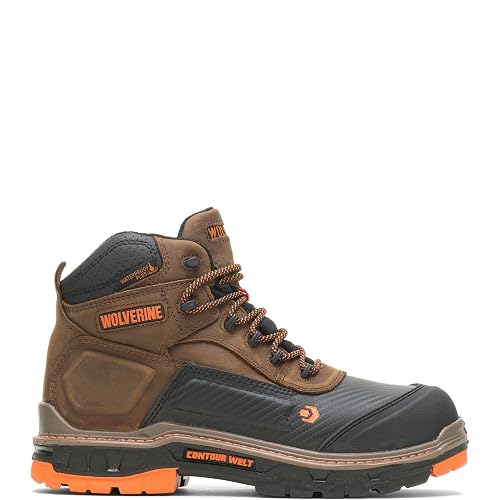
Wolverine Men's Overpass Composite Toe Waterproof Work Boots
Weight and Fatigue: Winner: Steel Toe Safety Sneaker
Weight is where the low-cut safety sneaker has a clear advantage. Lighter footwear reduces the effort your legs put in over a long shift, and a sneaker-style shoe is generally lighter than a full-height boot with a steel toe. If you walk several miles a day on concrete, that difference adds up. The composite boot is lighter than a comparable steel toe boot because composite caps are typically thinner for the same rated protection, but it still carries the weight of a full leather boot upper.
Many workers find that a few ounces saved per foot makes a noticeable difference by late afternoon. If you spend most of your day standing or moving across flat floors, the lighter sneaker is the more comfortable choice.
Metal Detectors and Site Access: Winner: Wolverine Overpass Composite Toe
This is the single biggest practical difference. Steel toe caps set off metal detectors at airports, prisons, nuclear plants, some manufacturing facilities and certain construction sites. Composite toes do not trigger those detectors. If your site requires you to pass through a metal detector each day, a composite toe is the safer bet for avoiding delays and frustration.
Check your site’s rules before you buy. Some employers accept steel toes with a documented exemption, while others require non-metallic footwear. If your site’s policy is unclear, ask your supervisor or safety officer before you buy.
Cold Weather and Temperature Transfer: Winner: Wolverine Overpass Composite Toe
Steel conducts heat and cold efficiently, so a steel toe cap can feel noticeably cold in winter conditions. Composite caps transfer less cold, which helps keep toes warmer on cold concrete, in cold storage areas or during outdoor winter work. Composite toes are not insulated, so a warm sock and a boot with a suitable lining still matter. For workers in very cold climates, composite is the more comfortable option.
Waterproofing and Wet Conditions: Winner: Wolverine Overpass Composite Toe
The Wolverine Overpass is marketed as waterproof, which makes it suitable for wet ground, puddles, washdown areas and muddy job sites. The steel toe sneaker has a breathable upper designed for dry, warm environments. Breathability helps reduce sweat, but it also means water can get in, so it is not the right choice for wet work. If your job involves standing water or frequent wet conditions, choose the boot.
Ankle Support and Stability: Winner: Wolverine Overpass Composite Toe
A full-height boot supports the ankle better than a low-cut shoe, especially on uneven ground, ladders, loose gravel and rough terrain. A low-cut safety sneaker offers less lateral support, so it is better suited to flat, predictable floors. Workers who roll their ankles easily or work on uneven surfaces should prefer the full-height boot. Anyone with an existing ankle or foot condition should consult a physician or a qualified footwear professional before choosing footwear for medical reasons.
Fit, Break-In and Sizing: Winner: Steel Toe Safety Sneaker
Sneaker-style safety shoes generally need less break-in than a full leather work boot. A full-height boot often requires several days to a few weeks of wear before the leather softens and the heel settles. Measure both feet in the afternoon, when they are largest, and fit to the larger foot. Leave roughly a thumb’s width of space at the toe when standing, and make sure the heel does not lift more than a small amount when you walk. Wear the socks you will use at work when you try on any safety footwear.
Because the sneaker is marketed with a wide-fit option, it may suit people with broader feet. Check the listing’s width information before ordering, and always confirm sizing against the maker’s size chart.
Protection Ratings and Standards: Winner: Tie, Check the Label
Steel and composite toes can both meet the same impact and compression ratings under ASTM F2413. The toe material does not determine the protection level on its own; the rating printed on the boot does. Look for the ASTM F2413 marking and the specific impact and compression codes, such as I/75 and C/75 for the standard levels. Confirm that the footwear you buy carries the rating your job requires, and do not assume a steel or composite toe automatically meets a higher standard.
Durability and Cost of Ownership: Winner: Depends on Use
Steel toe caps do not degrade with normal wear, and they hold their shape over time. Composite caps are also durable, but they can be thicker or heavier in some designs, and the rating depends on the specific product. Owners often report that full-leather work boots last longer with regular cleaning, conditioning and rotation between pairs than lighter sneakers do, which tend to wear out faster on the outsole and midsole. Since both products are priced differently, compare them by expected service life on your job, not by sticker amount alone.
Which Should You Choose?
- Choose the steel toe safety sneaker if you work on dry, warm, flat floors, want the lightest possible footwear and do not pass through metal detectors. View on Amazon
- Choose the composite toe boot if you need to pass through metal detectors, work in wet or cold conditions, or need ankle support on uneven ground. View on Amazon
- Choose steel toe (any boot, not necessarily these products) if your site accepts metal and you want the most compression resistance in a long-wearing leather boot.
- Choose composite toe if you want a lighter-feeling toe box than steel while keeping full-height protection and staying clear of metal detectors.
- Check your site policy first. The right toe type is the one your employer and job site allow.
FAQ
Are composite toe boots as safe as steel toe boots?
Both can meet the same ASTM F2413 impact and compression ratings. Check the rating printed on the specific boot rather than assuming one material is safer than the other.
Do composite toes set off metal detectors?
No. Composite toe caps are non-metallic, so they generally pass through metal detectors without setting them off. Steel toe caps usually do set them off.
Which is better for cold weather?
Composite toes transfer less cold than steel, so they are generally more comfortable in winter. Warm socks and a suitably insulated boot still matter.
Do I need a full boot or is a safety sneaker enough?
A safety sneaker is lighter and needs less break-in, but a full-height boot gives better ankle support and is more suitable for wet or uneven ground. Choose based on your work surface and conditions.
How should I size safety footwear?
Measure both feet later in the day, fit to the larger foot, wear your work socks, and leave about a thumb’s width at the toe. Confirm sizing against the maker’s size chart, and consult a qualified fitter if you have foot health concerns.
Conclusion
Steel toe vs composite toe work boots is ultimately a question of environment. The steel toe safety sneaker suits warm, dry, flat workplaces where weight matters most. The Wolverine Overpass composite toe boot suits metal-detector sites, wet and cold conditions and anyone who needs full ankle support. Confirm the protection rating on any boot you buy, check your site’s footwear policy, and fit the boot to your larger foot with your work socks on.
Related reading
- 6 Best Work Boot Accessories for Comfort and Protection (2026)
- 6 Best Waterproof Work Boots for Wet Jobsites: Top Picks (2026)
- 6 Best Boot Care Products: Picks for Leather, Suede and Work Boots
- 5 Best Slip-Resistant Work Boots: Top Picks Compared (2026)
- 10 Best Boot Socks for Work, Hiking and Winter: Picks Compared (2026)
- 10 Best Boot Laces Compared: Top Picks for Work, Hiking and Winter Boots (2026)
- 10 Best Boot Insoles for Work Boots and All-Day Comfort (2026)
- 10 Best Boot Brushes for Cleaning Leather, Horsehair and Work Boots